
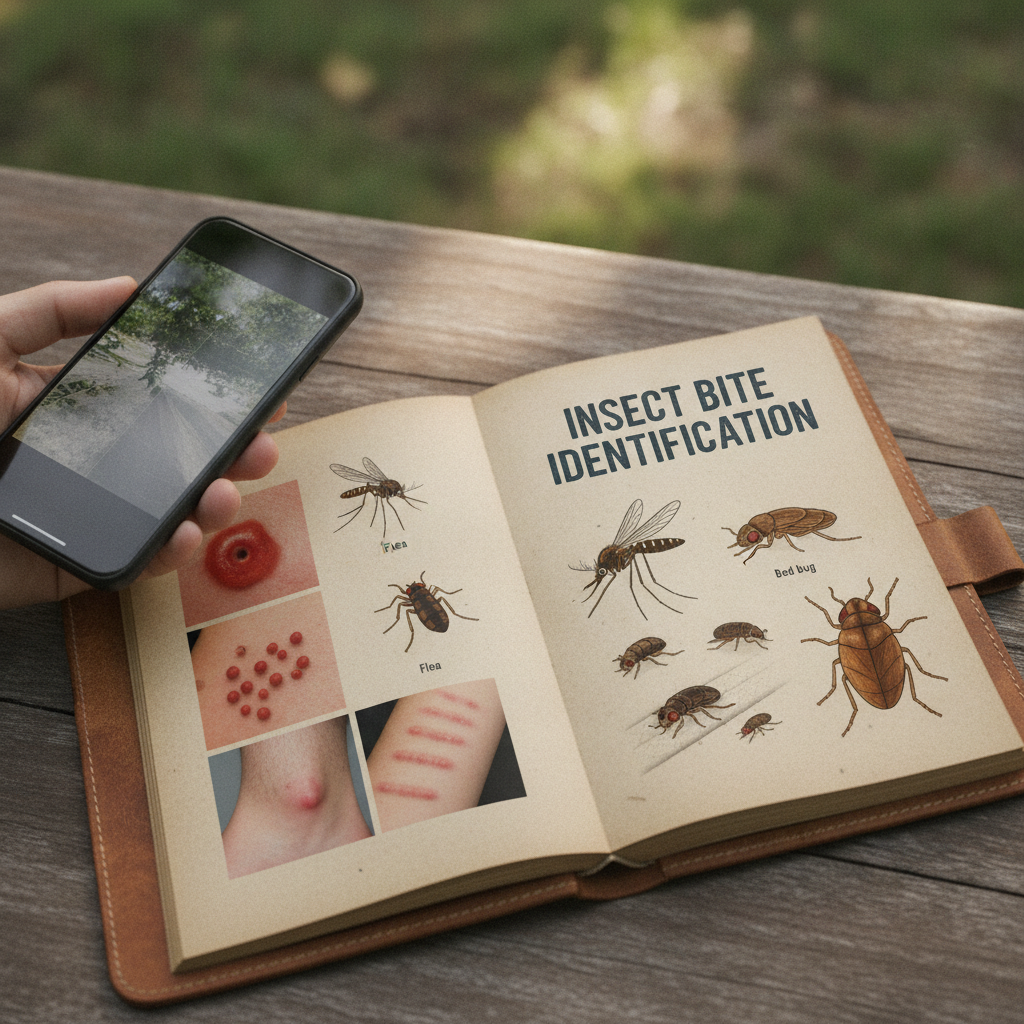
What Insect Bite Pictures Identification Really Means
In my teaching, students often arrive with phone galleries full of red bumps and a single urgent question: what bit me? Insect bite pictures identification is the practice of matching those skin reactions to known arthropod feeding patterns using visual evidence. It sits at the intersection of entomology, dermatology, and practical observation — a skill anyone can develop with structured guidance and realistic expectations about what photographs can and cannot reveal.
The skin responds to arthropod saliva with a limited palette of appearances. Edema, erythema, pruritus, and occasionally vesicle formation create welts that look interchangeable at first glance. What distinguishes species in identification atlases is not usually a single welt's color but the ensemble of features: how many marks, how they arrange in space, where on the body they concentrate, how they evolve over hours and days, and what environmental exposure preceded them. A skilled identifier reads the photograph the way a lepidopterist reads wing venation — pattern first, fine detail second.
This guide organizes insect bite pictures identification around visual taxonomy. Rather than scrolling endlessly through image search results, you will learn to classify bite photos into pattern families, match those families to species groups, and confirm with contextual evidence. The approach mirrors how entomology labs train technicians to use pictorial keys — systematic, reproducible, and honest about uncertainty.
The Visual Taxonomy of Bite Photos
Professional identification atlases group bite pictures by morphology before assigning species names. Learning these groups accelerates your analysis before you consult any reference image. The scattered bite group contains isolated or loosely distributed marks typical of mosquitoes, gnats, and deer flies. The clustered group packs multiple small lesions into tight zones — fleas, chiggers, and fire ants. The linear group arranges bites in rows or gentle curves — bed bugs and occasionally chiggers following clothing seams. The solitary lesion group shows one significant mark — spiders, ticks, horseflies, and solitary wasp stings.
Within each group, size and texture refine identification. Mosquito scattered bites range from four to twenty millimeters with smooth, dome-shaped swelling. No-see-um scattered bites run smaller — one to three millimeters — and far more numerous, sometimes dozens on a single forearm. Flea clustered bites stay at two to three millimeters with sharp margins and intense central redness. Chigger clusters contain slightly larger papules with excoriation from scratching visible in photos taken forty-eight hours post-exposure.
Progression photography adds a temporal dimension to visual taxonomy. Static atlases show bites at one time point; your identification improves when you compare your photo series against known progressions. Fire ant stings evolve from red bases to white pustules within twelve to twenty-four hours — a transformation captured beautifully in sequential medical photography. Bed bug bites may remain invisible at twelve hours post-feeding then emerge as flat erythematous macules at seventy-two hours. Tick bites show persistent central attachment marks with optional expanding erythema rings over days.
Species-Specific Picture Profiles
Mosquito bite pictures dominate atlases because Culicidae feed on every continent except Antarctica. Reference images show erythematous papules and wheals with central pallor, typically on exposed skin after crepuscular outdoor activity. Multiple species produce similar pictures — Aedes, Anopheles, and Culex cannot be distinguished from bite photos alone. Geographic context and disease risk assessment require species identification of the insect, not the welt.
Flea bite pictures emphasize small, firm papules grouped at anatomical sites where fabric meets skin. Atlases often include companion images of flea dirt in pet fur and carpet fibers because bite pictures alone overlap with chigger presentations. The pet exposure context visible in case histories — not the photo itself — frequently resolves flea versus chigger ambiguity.
Bed bug bite atlases pair skin photos with environmental evidence. Cimex lectularius produces highly variable individual reactions, from no visible mark to dramatic urticarial wheals. Identification from pictures relies on the breakfast-lunch-dinner linear arrangement on sleep-exposed skin combined with photos of mattress harborage, molted exoskeletons, and fecal spotting. I teach students to never diagnose bed bugs from a single welt photo without distribution and environmental corroboration.
Hymenopteran sting pictures differ categorically from biting insect photos. Bees and wasps leave immediate pain, central puncture, and localized swelling that may spread over twenty-four hours. Fire ant pictures show the distinctive pustule stage unique among common household arthropods. Yellow jacket stings often occur around food and beverage containers during late summer picnics — context visible in case descriptions accompanying atlas images.
Spider bite pictures require the most skepticism in any identification collection. Peer-reviewed literature confirms that most presumed spider bite photos submitted to clinics show bacterial abscesses, pyoderma, or herpetic lesions instead. True araneomorph bites — when confirmed — present as solitary lesions, sometimes with central cheliceral marks, at sites of accidental contact. Atlases from reputable arachnological sources show confirmed bites with captured specimens, not internet horror stories.
How to Read an Identification Atlas
Not all insect bite pictures identification resources are equal. Evaluate atlases by source authority, case documentation, and species verification. University extension bulletins, CDC publications, and dermatology textbooks provide verified images with clinical histories. Pinterest boards and unmoderated forums propagate mislabeled photos that confuse more than they help.
When reading an atlas entry, examine the full case record accompanying each image. Reliable entries document patient age, exposure activity, geographic location, time since bite, and whether the biting arthropod was captured and identified. An photo labeled "probable mosquito" with no supporting context carries less weight than one labeled "Aedes albopictus confirmed, specimen retained" with matching bite presentation.
Compare multiple atlas entries for the same species before concluding your bite matches. Individual variation is the rule, not the exception. If your photo falls within the range shown across five confirmed mosquito bite images but matches none exactly, mosquito remains a reasonable hypothesis. If your photo matches no entry in any species profile, broaden your pattern group analysis before forcing a species name.
Cross-reference dermatological atlases when arthropod sources disagree. Conditions like erythema migrans, contact dermatitis, and folliculitis mimic bite presentations in photographs. The differential diagnosis section of medical atlases helps exclude non-arthropod causes that picture-matching alone might miss.
Creating Your Own Identification Photo Set
Citizen science benefits from well-documented bite photo collections. If you experience recurring bite events, create a structured personal atlas. Photograph each episode with consistent technique — same lighting, scale reference, and angle — and record metadata in a simple spreadsheet: date, time discovered, body location, activity last twenty-four hours, weather, geographic location, and resolution timeline at six-hour intervals.
When you eventually capture the responsible insect, photograph it immediately alongside the bite photo in your collection. This paired documentation is the gold standard for household insect bite pictures identification. My lab receives more correct submissions from homeowners who bagged the bug than from those who photographed welts alone.
Share your documented sets with local extension offices when household infestations persist despite treatment attempts. Pest management professionals use cumulative photo evidence to distinguish fleas from carpet beetles causing dermatitis, bed bugs from bat bugs, and bird mites from rodent mites — identifications that require specimen examination but start with your visual case file.
Technology and Picture Identification
Machine learning systems trained on dermatological and entomological image sets offer automated insect bite pictures identification with improving accuracy. These tools analyze color histograms, lesion borders, spatial distribution detected across uploaded images, and metadata tags you provide. They perform best as ranking engines that suggest probable categories rather than definitive species diagnoses.
Insect Identifier and related apps prioritize insect specimen photos over bite marks because taxonomy models trained on arthropod morphology outperform those trained on inflammatory skin responses. When a student uploads a bite photo alone, I recommend they first deploy the app on any insect found nearby — windowsill spider, kitchen ant, bedroom bed bug — because connecting species to bite pattern beats analyzing histamine patterns computationally.
Combine automated suggestions with manual pattern taxonomy for best results. If an app suggests flea with seventy-percent confidence and your atlas reading shows ankle clustering after cat exposure, confidence appropriately increases. If an app suggests brown recluse from a solitary welt without geographic plausibility or confirmed specimen, reject the output and consider non-arthropod differentials.
Frequently Asked Questions
What is the difference between bite and sting pictures?
Bite pictures typically show multiple small papules or wheals from blood-feeding insects. Sting pictures often show fewer marks with more swelling, central puncture, and acute pain — characteristic of bees, wasps, and fire ants.
Can insect bite pictures identification determine disease risk?
Pictures alone rarely confirm vector-borne disease. Tick bite photos with bullseye rashes warrant medical evaluation for Lyme disease, but many erythema migrans cases need laboratory confirmation beyond photography.
Why do identical insects produce different bite pictures?
Immune response variation drives appearance differences. IgE-mediated hypersensitivity, prior exposure history, and skin thickness at the bite site all modify the photographic presentation.
How many reference pictures should I compare before deciding?
Review at least three confirmed images per candidate species plus check whether your photo fits a pattern group. Convergence across multiple references increases reliability.
What app identifies insects from photographs?
Insect Identifier analyzes insect and spider photos using AI, providing species information that connects to typical bite presentations. Download it free on the App Store.
Download Insect Identifier Today
Building your insect bite pictures identification skills pairs perfectly with identifying the arthropods themselves. Insect Identifier puts expert-level species recognition in your pocket — snap a photo of any insect, spider, butterfly, or bug and receive detailed information within seconds.
The app covers thousands of species with habitat notes, behavior details, safety information, and identification history you can export as PDF. Save every discovery and build your personal field journal.
Download Insect Identifier on the App Store and start identifying the insects around you today.